



















This article originally appeared in the Fort Worth Weekly
the week of May 10, 2001
Fort Worth Weekly Online -- fwweekly.com | arts]
05/10/2001
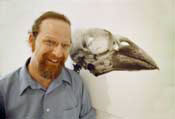
Dick Lane's photos
go beyond the cliches of pain.
By Nancy Schaadt
New lease on life. Near-death experience. Dead tired. These
unimaginative cliches say little about recovering
from illness, fatigue,
or almost dying. College professor and fine art photographer Dick Lane, 43,
lived those
phrases, when a wrongly diagnosed illness robbed him of nearly
three years of his life. And though he
occasionally slips into artistic
hyperbole, a talk with him makes it plain that there is nothingcliched
about his
experience.
Lane's photographs, along with work by eight other contemporary
Arlington artists, are on exhibit at the Arlington
Museum of Art through
June 2. The exhibit is called Within Sight and features fluid glass sculptures
by
David W. Keens that seem to float near the floor, while Benito Huerta's
towering and aggressive Noches de la
Frontera dominates the right-hand
side of the room.
Patterned After Biggers by Celia Munoz is both homage and
art. The Biggers row-housing project in Houston
provides workspace for
artists in residence as well as interim housing for women. The "before" photographs
in
the installation show women metaphorically entering a dark and lonely
house. The "after" shots are brighter
and depict the same women
reunited with their children.
With the artistic double whammies of Huerta and Munoz downstairs
and fantastical woodcut prints by Nancy
Palmeri on the second floor, it
is easy to overlook the more organic works of Julia Franklin, Nicholas
Wood, and
Lane. With Revealing the Heel, Franklin explores one element
of one everyday item --the shoe heel -- with 51
real and interpretive heels
in tidy, square frames.
Nicholas Wood strips layers of paint from geometric wooden
constructions to reveal op-art patterns. His work
is both sculptural and
organic.
Andrew Ortiz uses a computer to manipulate multiple-exposure
images printed on a large-format inkjet printer.
The images are deliciously
science-fiction. Ordinary images take on a spooky mien, as though a gigantic
Polaroid instant photographhad been left out in the sun.
Leighton McWilliams uses the shadow-box concept to create
a multi-dimensional work reminiscent of a peep
show. The exhibit also includes
McWilliams' mildly erotic photographs of military aircraft.
And then there's Dick Lane's works. Twenty-seven 4-by-5-inch
contact prints of dead things march across the
white gallery wall like
so many teeth in a grinning skull. Some photographs are clinical and matter-of-fact
--
bones or a bird's head captured on film. Some are abstract. A seed in
a pod is sensual, reminiscent of
Georgia O'Keeffe, while the partial frog
specimen is near grotesque -- the animal's once-soft skin is now
stretched
taut and dry. Other shots are arranged bits of bone and other matter, so
detached and scholarly
that they might belong in a textbook or a natural
history museum.
The images reflect a different man than the one who used
to enjoy physically involved photography and
manipulating prints and negatives.
Lane manhandled cameras. He set scenes. One of his earlier works is a
photograph
of a tree illuminated with 30 candles glimpsed through a hole in a wall.
In 1993, Lane was wrestling with a series of works, literally.
Allegory for Modern Times was a collection of
mammoth, 4-by-5-foot mixed-media
photographic works he created by chopping 8-by-10-inch negatives into
squares,
then enlarging and printing the squares to form an eye-popping whole. "I
was very happy with the
work," he said.
That part of his artistic life came to a halt in August 1993. "I
got sick with stomach pains and cramps," he said.
After a week in
the hospital, he was diagnosed with Crohn's Disease, an auto-immune disease
that affects
the digestive system and causes inflammation and ulcers. It
can be treated with antibiotics and immune-system
suppressants, but it
cannot be cured.
In the next 18 months, he would be hospitalized two more
times because his doctor couldn't get the Crohn's
under control. "I
felt good for maybe two weeks in two and a half years," Lane said.
Although he was glad that
he wasn't going to die from Crohn's, he said
the illness felt like poison. "I think I even said to my wife that
I think
I'm getting poisoned," he recalled.
While ill, he continued to work as a photography instructor
at Texas Christian University, but he couldn't create
art. He went to work,
came home, and slept. Lane did find victory in teaching. "I didn't
think I could do that
[create art] again, but what I could do was be a
really good teacher," he recalled.
"People don't realize how physically demanding artwork
can be. An 8-by-10-inch view camera is a big object,"
he explained.
The work required strength and stamina, but Lane had neither. "I actually
considered the fact
that I may never make a body of work again," he
recalled. "It's depressing."
The third time he was hospitalized, his doctor was out of
town. The diagnosis was quite different. The new
physician reviewed Lane's
history and gave a new diagnosis: appendicitis. He was given massive doses
of antibiotics and prepared for surgery.
After surgery he was told that his appendix had ruptured
two or three times. "They couldn't tell exactly," Lane
said, "because
some of it was gone." It turns out that people don't always die from
a ruptured appendix.
Sometimes they suffer for years. After surgery, it
was a full year before Lane felt well again.
He doesn't believe he handled the illness in an extraordinary
way. "Lots of people have done courageous
things," he said. But
he admits that it was a defining moment in his life.
It also changed his art. Rather than schlep a large-format
camera or manipulate photographs, he turned his
garage into a B-movie laboratory
of batteries and copper plates and began exploring Kirlian photography.
"It's
photography without the camera," he explained. Kirlian photography
captures patterns of energy in
objects that are exposed to electrical current.
The resulting images have a random, surrealistic quality.
"Kirlian
still uses light, but a different kind of light,"he added.
At the same time, he was making pictures of bones, pods,
and other found organic material. Photographs
from that body of work, titled
Specimens, are among his photographs on display at the Arlington museum.
The materials were arranged on a light table and photographed.
The resulting images have a moderate
gross-out factor, yet are majestic
and ultimately respectful of the once-living animals. Museum director
Anne
Allen said the work is intriguing. "The cat face in a death mask is
surprising because it looks abstract,"
she said. "When you look
closer, you are in fact dealing with something that was once living."
Lane's pre-1993 work was heavily manipulated, echoing one
of his favorite phrases: "What are the
possibilities?" He pulled,
cut, staged, and illuminated his art because he says he likes to mess things
up.
But the specimen photographs are simple and stark. "Sometimes
no manipulation is one of the possibilities,"
he said. He did mess
things up a little. The photographs are toned silver prints; essentially
a color is added
that warms the stark black-and-white image.
Lane sees nothing unusual about making pictures of a leaf's
energy patterns using Kirlian techniques, or
making fine-art photographs
of roadkill. He explained that the cycle of existence must encompass all
things.
"Contact with nature," he said, "is essential to
our psyche. Cave paintings [exist] because they understood
that their connection
with nature is a matter of life or death."
Lane said it doesn't matter that the objects he photographs
are dead. "It's not significant that they are dead.
The specimens
are Zen-like. I have a feel for these objects that resonates with my life.
"It's not just about being sick, it's being aware of
the possibilities." After making 120 photographs in the series,
how
much farther can Lane take Specimens? "It should end soon," he
said, "but people keep bringing me
dead things."
top----------------------------------------------------------
©2001 New Times All rights reserved